Stage Six - Wooler to Fenwick
(11.5 miles / 19 kms, with Max Ascent 850 ft / 260 metres)
 St. Mary's Church |
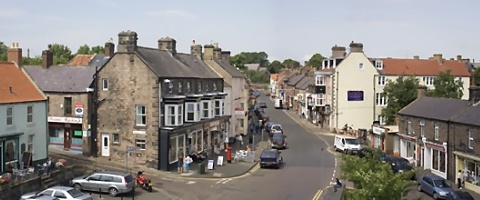
Leaving the town by Church Street, you will pass St Mary's Church. There has been a religious building on this site since the twelfth century, but the present building is from the middle of the 18th century. Passing the Police Station, crossing the main road to Alnwick and passing the bowling club and the school, you are soon out onto the clear track leading to Weetwood Moor.
 Weetwood Bridge |
From the top of the hill there is a fine view down to Weetwood Bridge and the valley of the Till. There was a bridge here at the time of the Battle of Flodden, as the English army are recorded as crossing here. Having followed the track down and across the bridge, the road bears right skirting the grounds of Weetwood Hall and heading for Doddington Moor. The quarry on the moor was the source of a fine pink sandstone which was used for many of the houses in Wooler.
Today the name Doddington is more often associated with a fine hard cheese. Also on the moor is Cuddy's Cave, which legend has made the place where Cuthbert was a shepherd, but there is no other evidence to support this. The use of the word 'Cuddy' is also found in 'Cuddy's Ducks', an affectionate name for the eider ducks which you may see around Holy Island.
 St. Cuthbert's Cave |
On reaching West Horton, you will follow, for a short distance, the Roman road known as the 'Devil's Causeway'. This road ran from Tweedmouth to Corbridge, linking what was a very important port to the main fort on the eastern part of Hadrian's Wall, and allowing an easy supply route to the garrison there.
After leaving the Roman road, the track takes you across the Hetton Burn and on to St Cuthbert's Cave Wood, which is in the care of the National Trust. Close to the wood is the actual cave.
This dramatic sandstone overhang is the place to which, it is reputed, the body of St Cuthbert was taken when Lindisfarne was attacked by the vikings in 875 AD and the monks had to flee to safety, taking the sacred remains with them. The monks carried their burden with them for the next eight years before they settled at Chester-le-Street. St Cuthbert's remains stayed there until 995 AD when they were moved to a little church in Durham which had been specially built to house them. There they remained until the building of what is now Durham Cathedral.
Returning to the path, and working your way uphill over the saddle between Greenshaw Hill and Cockenheugh, down across the Middleton Burn, and back uphill onto the skyline, at Fawcet Hill, brings you on a fine day, a panoramic view of everything between Bamburgh and Lindisfarne Castle, including the Farne Islands.
 Holy Island from Fenwick |
From here the route takes you northwards towards Fenwick village with its granaries. Near to Fenwick you will pass through Kyloe Old Wood, which in the 19th century was owned by the Leyland family of nearby Haggerston Castle. The family name has remained in what many modern-day gardeners regard as the curse of all hedging plants - cupressus leylandii, which was originally raised here.
In the nautical world, Christopher John Leyland is remembered for his sponsorship of the first steam turbine-powered vessel, the 'Turbinia', which in 1897 managed to reach 34 knots. The vessel is now in the Discovery Museum in Newcastle. From Kyloe Old Wood, the road leads into the village.
Stage Five - Yetholm to Wooler | Stage Three - Harestanes to Morebattle